
When the Goods and Services Tax (GST) was introduced in 2017, it was meant to revolutionize India’s indirect taxation system. However, the early days were far from smooth. Opposition leaders even branded it as the “Gabbar Singh Tax” — a burden that loomed large over businesses. The reasons were clear: increased compliance burden, complexity for small businesses, higher tax rates on certain goods, technical glitches, economic disruption, and inadequate training made the rollout challenging.
—
Evolution of GST
Despite the rocky start, GST has undergone a significant evolution. Over the years, the government worked on rationalising the structure, reducing the number of tax slabs, and addressing many of the initial concerns. With these reforms, what was once criticised as “Gabbar Singh Tax” gradually began to live up to its intended name — “Good and Simple Tax.”
—
The Latest Shift: GST 2025 Rate Revisions
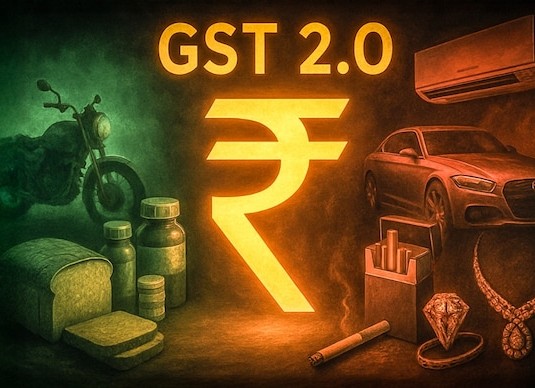
As GST continues to evolve, the year 2025 brings yet another major reform. The GST Council has revised rates for various goods and services, with many food items seeing a tax reduction. These changes, effective from September 22 (Navratri onwards), are aimed at further simplifying the tax structure and easing the burden on consumers. However, items like gutkha, tobacco, and cigarettes remain exceptions and continue to attract higher taxes.
—
Impact on Consumers and Businesses
The 2025 GST revisions are expected to bring noticeable relief. With cheaper essential items, households will feel less pressure on their daily expenses. On the industrial front, reduced rates on key goods are likely to encourage higher consumption and investment, driving business growth. At a time when global tariffs and economic pressures are rising, these revisions aim to provide a much-needed boost to the Indian economy.
—
Conclusion
The journey of GST in India has been far from linear. What began in 2017 as a complex and often criticised system is gradually evolving into a more streamlined tax framework. The government’s consistent efforts — from reducing the number of tax slabs to revising rates in 2025 — reflect the need to balance revenue collection with economic growth. While challenges still exist, GST has undeniably become a cornerstone of India’s indirect taxation system. Its future effectiveness will depend on how well it adapts to changing economic conditions and the needs of both businesses and consumers.
 CodeWithKriti
Leave a comment