
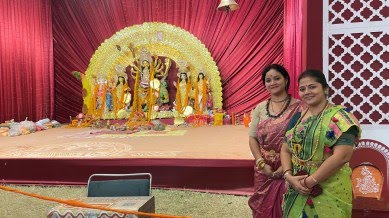
When I first came across the headline, “Devi maa ki puja toh devi hi karegi na,” I felt a mix of pride and curiosity. It instantly drew me in—not because it was shocking, but because it felt powerful and long overdue. I had read earlier about women purohits performing weddings and rituals in different parts of India, so this didn’t feel entirely unfamiliar. But still, every time it happens, it feels like history is shifting a little.
The story of Priyanka Chakravarti and Neelanjana Ganguly—two trained women priests from Kolkata—leading Durga Puja rituals in Delhi’s Greater Kailash 2 is more than just a cultural event. It is symbolic, courageous, and quietly revolutionary. For as long as I’ve known, priests have almost always been men. Yet, the devotees who show up with faith in their hearts are often women—our mothers, grandmothers, sisters. We have grown up seeing women nurture traditions, observe fasts, sing bhajans, and decorate pandals, while the final rituals were performed by men.
That has been the norm for generations.
But watching women step into the role of the priest—into a space so long guarded by tradition—feels like a gentle but firm rewriting of what is possible. It’s not aggressive, not confrontational, just deeply symbolic. If devotion has no gender, why should ritual?
The line, “Devi maa ki puja toh devi hi karegi,” stays with me. It doesn’t dismiss tradition—it expands it. It carries the quiet message that if goddesses can be worshipped with the highest honour, then women, too, have the right to lead that worship. It doesn’t scream rebellion; it whispers equality.
I don’t see this as an isolated event. I see it as the beginning of many such stories—where women who are interested, capable, and devoted step into spiritual roles without hesitation or resistance. If priesthood is about knowledge, discipline, and devotion, then why should it be reserved for only one gender?
This moment gives me hope. Not the loud, celebratory kind, but the kind that grows slowly—like the first crack in a long-standing wall.
Traditions don’t disappear when they evolve. They become more inclusive, more meaningful, more alive.
Maybe one day, seeing women perform puja rituals across India won’t make news at all. It will simply be normal. Until then, moments like these make us pause and ask—If the divine feminine is sacred, shouldn’t the women who worship her be trusted to lead too?
 CodeWithKriti
Leave a comment